
Rather than simply improving how the skin looks for a short period of time, regenerative treatments aim to support how the skin functions at a cellular level. The goal is healthier, stronger skin that is better equipped to repair itself over time.
One of the ingredients leading this movement is PDRN.
Although you may have seen it described online as "salmon DNA", that explanation only scratches the surface. PDRN has been studied for decades in the field of regenerative medicine and is now becoming increasingly recognised for its ability to support skin repair, improve skin quality and encourage healthier collagen production.
Let's take a closer look at what it is, how it works, and why it has become one of the most talked-about ingredients in skin rejuvenation.
What Is PDRN?
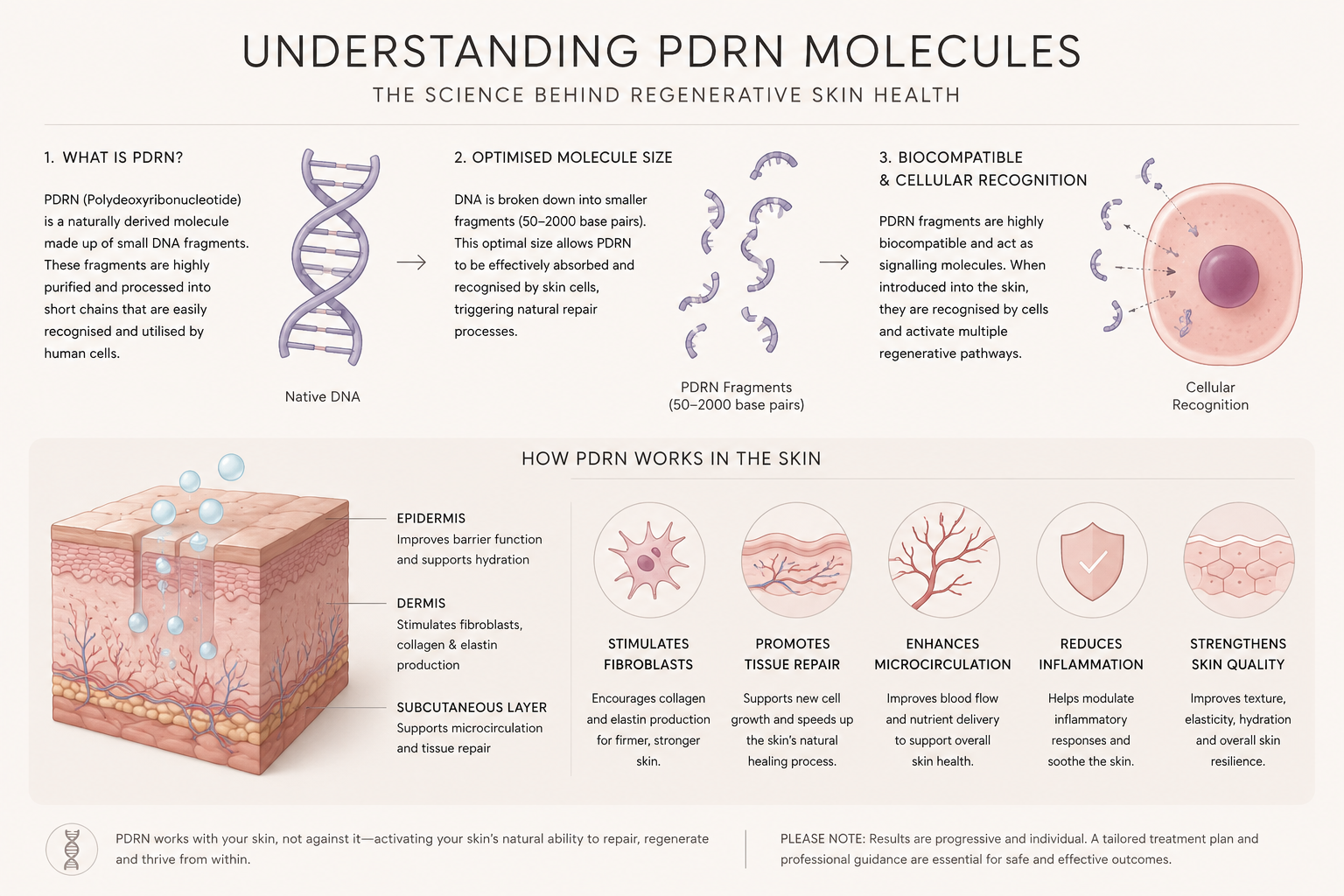
PDRN stands for Polydeoxyribonucleotide, a naturally derived molecule made up of small DNA fragments.
These DNA fragments are highly purified and have been researched extensively for their role in supporting tissue repair and wound healing. Before being introduced into aesthetic medicine, PDRN was used in medical settings to assist with healing damaged tissue, improving circulation and encouraging cellular regeneration.
In aesthetics, we use the same science to support healthier skin.
Rather than replacing your body's natural processes, PDRN works by creating an environment that encourages the skin to repair itself more efficiently. Think of it as providing your skin with the signals it needs to begin rebuilding and restoring damaged tissue.
This makes it quite different from treatments that simply hydrate the skin or temporarily improve its appearance.
How Does PDRN Work?
Our skin is constantly repairing itself.
Every day, collagen breaks down, cells are replaced, inflammation occurs, and tiny amounts of damage accumulate from UV exposure, pollution, stress and the natural ageing process.
When we're younger, our skin manages this repair process remarkably well.
As we age, however, that regenerative ability gradually slows. Fibroblasts become less active, collagen production decreases, healing takes longer and the skin's barrier becomes more vulnerable.
PDRN works by supporting many of these natural repair mechanisms.
Research suggests PDRN may help to:
stimulate fibroblast activity (the cells responsible for producing collagen and elastin)
encourage tissue regeneration
support healthy blood vessel formation (angiogenesis), improving nutrient delivery to the skin
assist in reducing inflammation
promote skin healing following injury or in-clinic procedures
improve overall skin quality over time.
Rather than forcing the skin to behave differently, PDRN supports the biological processes your skin already performs naturally.
This is one of the reasons regenerative aesthetics has become such an exciting area of medicine.
Why Is Collagen So Important?
Collagen is the structural protein that gives our skin strength, firmness and resilience.
From our mid-20s onwards, collagen production naturally begins to decline. Environmental factors such as UV exposure, smoking, chronic inflammation and oxidative stress can accelerate this process even further.
As collagen levels decrease, we begin to notice:
fine lines
loss of firmness
thinning skin
slower healing
reduced elasticity
changes in overall skin texture.
Supporting collagen production isn't simply about reducing wrinkles.
It's about maintaining healthy skin architecture so the skin can function optimally for years to come.
What Skin Concerns Can PDRN Help Address?
Because PDRN focuses on improving overall skin health, it can be incorporated into treatment plans for a wide range of concerns.
These may include:
early signs of ageing
fine lines and crepey skin
dull or tired-looking skin
compromised skin barrier
post-inflammatory healing
acne scarring
uneven skin texture
dehydrated skin
skin recovering after clinical treatments.
Rather than targeting just one concern, regenerative treatments aim to improve the quality of the skin as a whole.
Healthier skin often becomes stronger, calmer and more resilient over time.
Is PDRN the Same as a Skin Booster?
Not exactly.
While many injectable skin boosters are designed primarily to improve hydration using hyaluronic acid, PDRN focuses on supporting the skin's natural repair and regeneration processes.
Hydration certainly contributes to healthier-looking skin, but regeneration goes a step further.
Instead of simply replenishing moisture, regenerative treatments encourage the skin to function more efficiently by supporting collagen production, tissue repair and cellular renewal.
The two approaches aren't necessarily competing, they simply have different goals.
The most appropriate treatment will always depend on your skin concerns, overall health, treatment history and long-term goals.
At The Functional Skin Studio, every treatment plan begins with a comprehensive consultation. We take the time to understand not only what you're hoping to improve, but also the factors that may be influencing your skin beneath the surface.
Sometimes PDRN forms part of that plan. Other times, strengthening the skin barrier, addressing inflammation or focusing on lifestyle factors may be the best place to begin.
Our philosophy has always been to treat the skin that's in front of us.